


Carry on Bag Measurements: Airline Size Rules and Packing
You're at the gate, your carry-on looks perfectly reasonable, and then an agent points toward the metal sizer. The suitcase you measured as “21 inches” suddenly won't slide in because the wheels, handle housing, and overstuffed front pocket weren't part of your calculation. A few minutes later, you're repacking at the boarding podium or watching the bag disappear into the hold.
That frustration comes from treating carry on bag measurements as a description of the suitcase body. Airlines and airport sizers judge the entire external envelope. Wheels, handles, side pockets, straps, latches, and packed fabric all count. The safest approach is to measure the bag as it travels, not as it appears in a product photograph.
Table of Contents
- Why Carry On Bag Measurements Catch Travelers Off Guard
- How to Measure Your Carry On Bag Correctly
- Standard Carry On Dimensions Across Major Airlines
- International and Budget Airline Size Variations
- Choosing Luggage and Packing Systems That Actually Fit
- Your Pre-Flight Carry On Compliance Checklist
Why Carry On Bag Measurements Catch Travelers Off Guard
Your suitcase may meet the airline's published carry-on limit and still fail at the gate. A sizer checks the bag's complete outside envelope, not just the main compartment or the fabric body. Wheels, handle housings, rails, side pockets, latches, and packed panels all take up space.
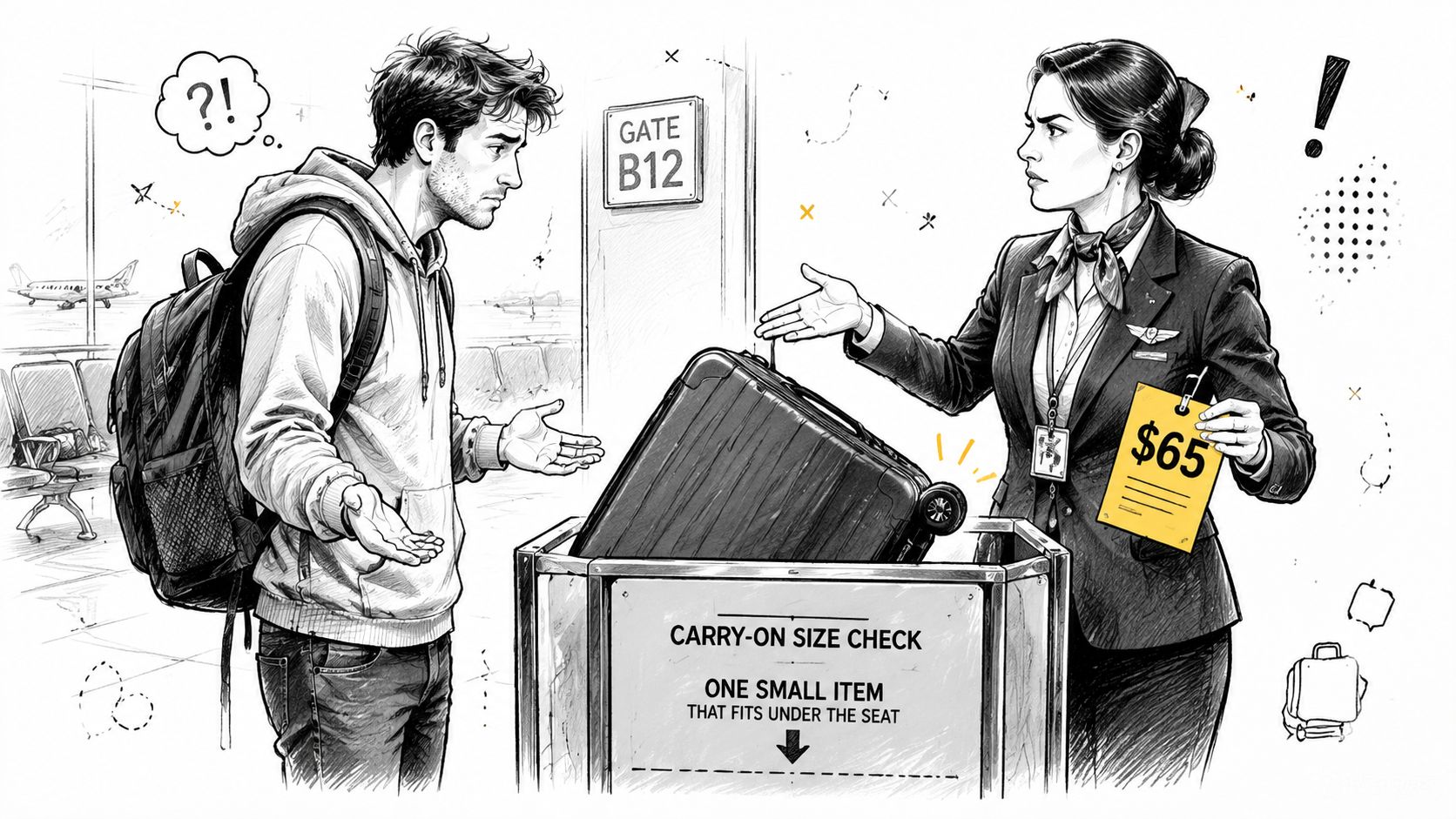
Product listings often make the mismatch harder to spot. A manufacturer may quote the suitcase body, while the airport sizer receives the wheels and handle structure too. A case labeled “21 inches” can therefore exceed the usable limit before you add anything to it.
Soft-sided luggage changes shape under load. Shoes, electronics, and tightly packed clothing can push the front panel outward, especially inside an external pocket. That pocket may lie flat at home and become the bag's deepest point at the airport. Compression helps only when the contents are distributed so the fabric can flatten instead of forming a hard bulge.
Hard-shell luggage is easier to predict, but it gives you no room to force a borderline fit. An oversized shell, wheel frame, or handle rail will not compress inside the sizer. Expansion zippers create another trap. The bag can fit with the panel closed, then exceed the limit after you open it.
Practical rule: Measure the suitcase at its widest and deepest points, including wheels and handle hardware. If the listed dimensions do not specify “including wheels and handles,” treat them as incomplete until you confirm what they cover.
Published limits also leave room for inconsistent enforcement. A lightly loaded flight may receive little scrutiny, while a crowded departure gives staff more reason to check borderline bags. Regional aircraft can create the same problem because their overhead bins may accept less practical bulk than the carrier's general policy suggests.
There has never been one universal hard ceiling. In 2015, IATA described its “Cabin OK” initiative around 55 x 35 x 20 cm, or about 21.5 x 13.5 x 7.5 inches, while identifying it as guidance rather than a mandatory standard. The historical carry-on measurement overview shows why that smaller benchmark still appears beside larger airline-specific limits. A familiar carry-on label does not guarantee that the actual bag will fit the airport box.
How to Measure Your Carry On Bag Correctly
A suitcase can match the airline's published dimensions and still fail at the airport sizer. The difference usually comes from wheels, handle housings, pockets, or soft fabric that expands after packing. Measure the bag in the same condition you will present it at the gate.
Use a flat floor and a rigid tape measure. Put the suitcase in its normal travel configuration. A flexible tape can follow curves and understate the outer envelope.
Measure the complete exterior
Pack the bag before measuring. Clothing pushes soft panels outward, so an empty case gives a false result. Close every zipper and leave expansion panels in the position you intend to use. Apply only the pressure you could realistically use while placing the bag in a sizer.
Measure each dimension separately:
- Height: Stand the bag upright. Measure from the lowest point of the wheels to the highest fixed part of the case or handle assembly. Check the telescoping handle retracted and extended, including its rails and housing. The fabric body alone is not the full height.
- Width: Face the suitcase toward you and measure its widest side-to-side point. Include side handles, pockets, wheel housings, latches, and fabric that bulges under load.
- Depth: View the bag from the side and measure the thickest front-to-back point. Include wheels, external pockets, expansion panels, straps, and other protruding hardware.
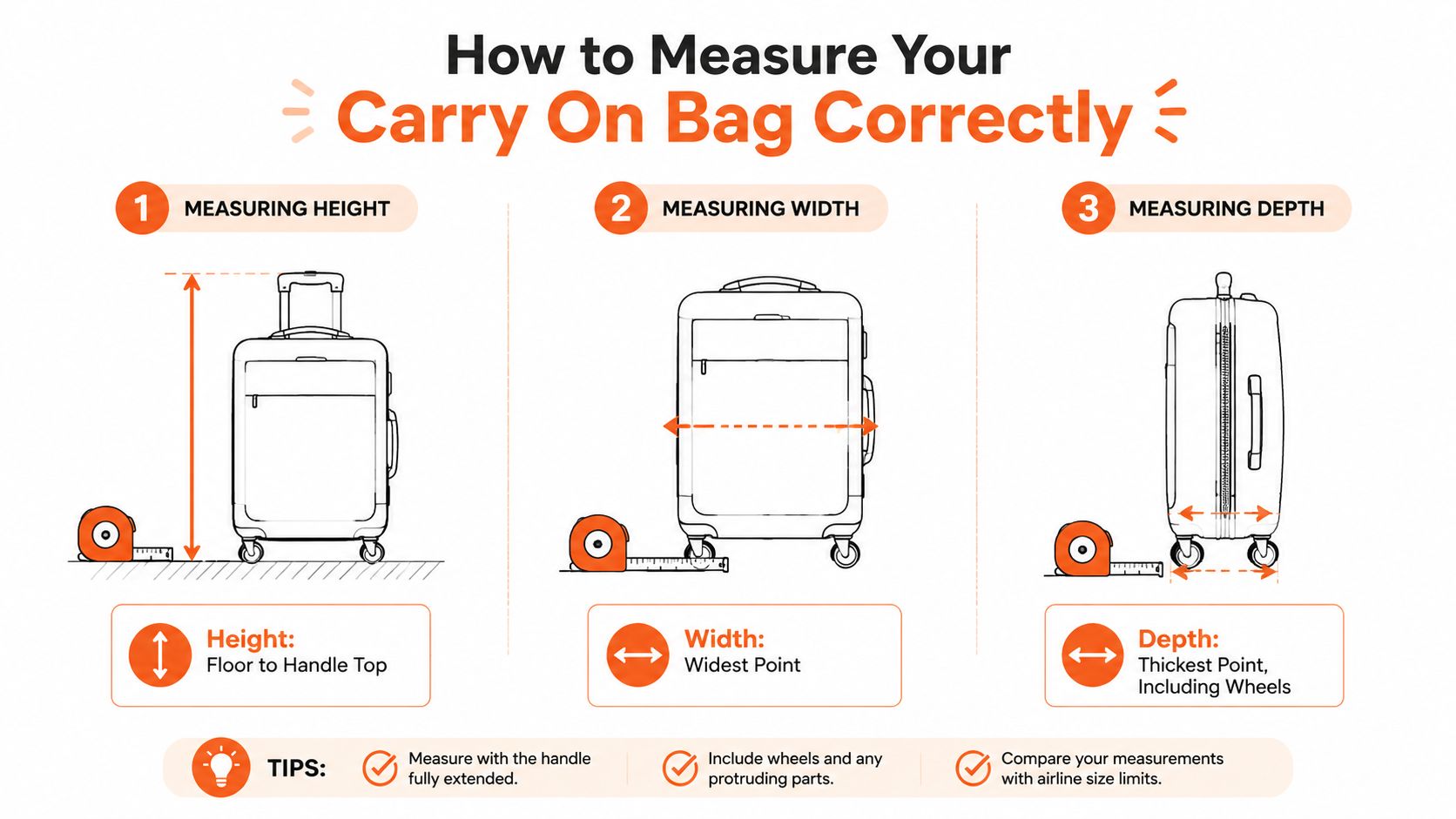
Wheels cause many measurement surprises. A product listing may show the body height while the wheel assembly adds more below it. Manufacturer specifications also differ in what they include. Look for overall dimensions or wording that confirms the wheels and handles are counted.
Compare the bag with the airline's envelope
Record height, width, and depth to the nearest half-inch. Compare each measurement separately with the airline's current policy. A compact overall volume does not compensate for one dimension that exceeds the sizer opening.
Leave a small buffer around the published limit. Bulging pockets and uneven soft panels can turn a borderline bag into a failed fit. If you use compression, compress the clothing first and measure the packed bag again. The VacuFly Travel Compression Kit, 15 Vacuum Bags + Cordless Pump removes air from compressible clothing and can reduce internal bulk. It cannot shrink a rigid shell or correct exterior dimensions that exceed the airline's limit.
For a visual demonstration, use this carry-on measurement walkthrough:
Check the VacuFly travel FAQs for packing-related guidance if the bag's construction is unclear. Then confirm the airline's own baggage page before departure. The airport sizer, rather than the retailer's product title, decides whether the bag fits.
Standard Carry On Dimensions Across Major Airlines
At a U.S. airport, a suitcase labeled “carry-on” can still stop at the sizer. Across major domestic carriers, the recurring published target is 22 x 14 x 9 inches, approximately 56 x 36 x 23 cm. That pattern covers American, Delta, United, JetBlue, Alaska, and other large carriers, while some airlines publish a roomier envelope. A current comparison of major-airline carry-on rules places those differences side by side.
| Airline | Max Dimensions (H x W x D) | Weight Limit | Regional Jet Notes |
|---|---|---|---|
| American Airlines | 22 x 14 x 9 in | Not specified in the cited policy | Check the complete bag, including handles and wheels, in the airport sizer |
| Delta | 22 x 14 x 9 in | Not specified in the cited comparison | Confirm the operating aircraft and current policy |
| United | 22 x 14 x 9 in | Not specified in the cited comparison | Depth deserves particular attention on smaller aircraft |
| Southwest | 24 x 16 x 10 in | Not specified in the cited comparison | More generous published envelope than the common U.S. baseline |
| JetBlue | 22 x 14 x 9 in | Not specified in the cited comparison | Confirm the allowance attached to your fare and itinerary |
| Alaska | 22 x 14 x 9 in | Not specified in the cited comparison | Check the operating carrier for partner segments |
American's carry-on baggage policy confirms that the bag must fit the airport sizer and stay within 22 x 14 x 9 inches, with handles and wheels included. That detail matters more than a product title or the dimensions printed on a retailer page. The airport measures the complete exterior presented at the gate, including protruding wheel housings, handle frames, and overfilled pockets.
The published limit is only half the test. A rigid case may meet the listed height while its wheels consume the remaining clearance. A soft-sided bag can compress clothing and panels, but a full front pocket can make its depth exceed the opening. Compression helps with flexible contents. It does not shorten a hard shell or move wheels inward.
I check depth first when comparing bags for different airlines. A case that is slightly narrower can still fail a 9-inch sizer if its front compartment is packed tightly. Width comes next, since broad wheel housings and side pockets can catch on the entrance. Height is easier to manage with recessed wheels and a compact handle housing, provided those parts are included in the measured dimensions.
IATA lists a broader technical reference of 56 x 45 x 25 cm, or 22 x 18 x 10 inches, including wheels and handles. Its guidance also notes that some airlines use weight limits beginning at 5 kg, or 11 lb, depending on the airline and itinerary. IATA's passenger baggage rules explains why the operating carrier's rules take priority over a generic industry reference.
Domestic airlines may not weigh every carry-on, but that should not determine your purchase. A partner airline can apply both size and weight checks, making a roomy case difficult to use even when its published dimensions look acceptable. Test the packed bag in a matching sizer before relying on its label.
International and Budget Airline Size Variations
A U.S. carry-on that passes one domestic sizer can become a poor choice once an international itinerary includes several operating airlines. Budget and international carriers often pair a tighter external envelope with a weight rule, creating two separate checks. Removing clothing reduces weight, but it cannot fix wheels that make the case too tall. A compact bag can also fail when the packed contents push it over the weight allowance.
Use the smaller design as your planning baseline rather than the roomiest domestic allowance. IATA's 55 x 35 x 20 cm Cabin OK guideline remains a useful compatibility benchmark, although IATA presents it as guidance, not a binding airline standard. It helps narrow your options, but it does not guarantee acceptance by every carrier.
| Airline | Max Dimensions (inches) | Weight Limit | Enforcement Level |
|---|---|---|---|
| European low-cost carrier | Varies by fare and cabin allowance | May apply | Often strict at the gate |
| Asian budget carrier | Varies by route and fare | Weight rules are common | Can be strict on both size and weight |
| Ultra-low-cost U.S. carrier | Varies by product and purchase | Check the ticket conditions | Fees and sizer checks can be decisive |
| International full-service carrier | Varies by cabin and route | Often specified | Confirm the operating airline |
| Regional partner flight | May use a smaller practical bin | May differ from the marketing carrier | Check every segment separately |
Do not treat a low-cost ticket as permission to test the limit. Gate staff may require the bag to enter a sizer, and a soft case filled with clothing can be harder to insert than its empty exterior suggests. Pressing down the fabric may help with a temporary bulge, but it cannot solve an overbuilt wheel base or a rigid frame that exceeds the opening.
Weight creates a second failure point. The IATA reference notes that limits often begin at 5 kg, or 11 lb, while broader travel guidance commonly discusses restrictions around 7 kg or 10 kg on international routes. These values are not universal. Check the allowance attached to your fare, cabin, and operating carrier before packing, because a heavy suitcase leaves less usable capacity even when its exterior passes the sizer.
A bag that flew free on a U.S. carrier is not automatically suitable for a European or Asian budget segment. Treat each airline and each connection as a separate compliance check.
Personal items need the same review. A backpack that fits under one aircraft seat may bulge on another when packed with a laptop, chargers, and a jacket. Keep it flexible, limit rigid items near the opening, and confirm that it can slide under the seat without depending on an empty front pocket or an uncompressed top section.
Choosing Luggage and Packing Systems That Actually Fit
Buy luggage around the strictest airline you expect to use, not the largest allowance on your itinerary. The compact Cabin OK benchmark of 55 x 35 x 20 cm offers a useful compatibility target because it is smaller than the commonly repeated U.S. limit, even though it remains a guideline rather than a universal rule. The carry-on size comparison provides the historical context for that distinction.
Exterior dimensions come before liters. A large-capacity bag is useless as an overhead carry-on if its wheel housings or expansion panel prevent it from entering the sizer. A smaller bag with controlled panels can carry more usable clothing because you can place and compress the contents without creating a protruding wall.
Hard shell or soft shell
Hard-shell luggage protects its shape. That predictability helps if the case is manufactured under the airline limit, but it gives you no margin when the exterior is even slightly too large. It also consumes interior space through shell thickness and wheel housings.
Soft-sided luggage offers a little more forgiveness. You can flatten a front pocket, compress clothing, and reduce a bulge before presenting the bag to the sizer. That flexibility becomes a disadvantage when the case is overfilled, because fabric expands exactly where the sizer needs clearance.
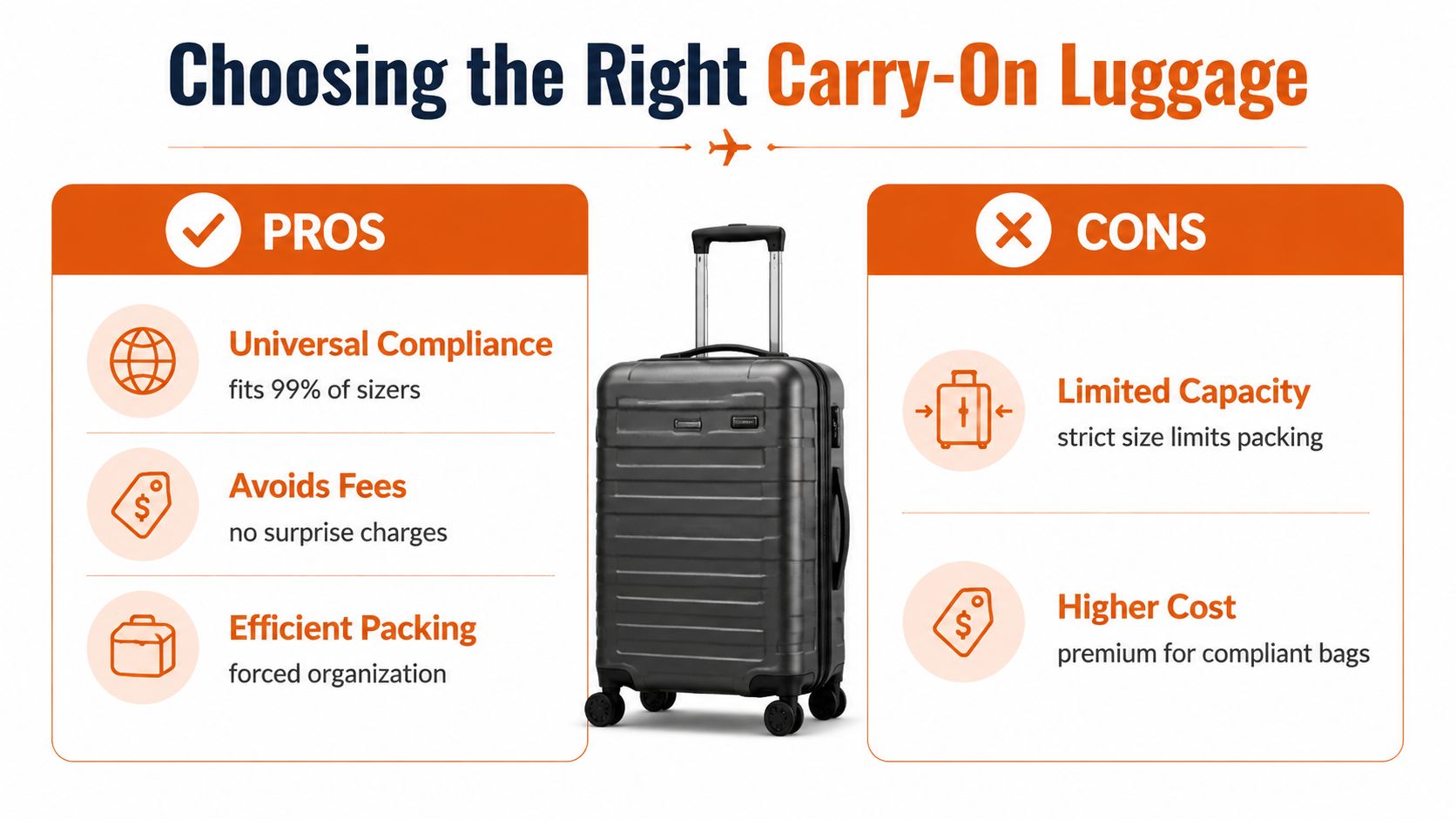
Look for design details that preserve the external envelope:
- Recessed wheels: Wheel assemblies tucked into the base reduce exposed height and protect the corners.
- Flush handles: A handle housing that sits neatly inside the case creates fewer protrusions than a bulky external rail system.
- Controlled expansion: Expansion is useful after arrival, but the unexpanded configuration must meet the airline limit.
- Flat front panels: A laptop pocket is convenient, but it should close without creating a deep packed bulge.
- External compression straps: These can restrain a soft case, although they won't overcome a rigid frame that's already oversized.
Packing systems work best when they control shape rather than create more room. Packing cubes separate categories, while compression bags remove air from soft clothing. The VacuFly travel-clothing guide describes that distinction in practical terms. Compression can make jackets, sweaters, pants, dresses, and everyday clothing easier to arrange, but it doesn't change the suitcase's wheels, handles, or hard shell.
Packing principle: Volume is useful only after the external skeleton fits. Measure the bag first, then use compression to fill that approved envelope efficiently.
Don't compress every item indiscriminately. Structured shoes, toiletry bottles, electronics, and fragile objects still need protection and shape. Put bulky, compressible clothing into a flat layer, keep rigid items near the center, and leave enough flexibility to close the bag without forcing the side panels outward.
Your Pre-Flight Carry On Compliance Checklist
A carry-on can pass at home and fail at the gate. The difference is often a packed front pocket, a wheel housing, or a handle that extends beyond the suitcase body. Check the complete bag before every trip, even if you have used it before.
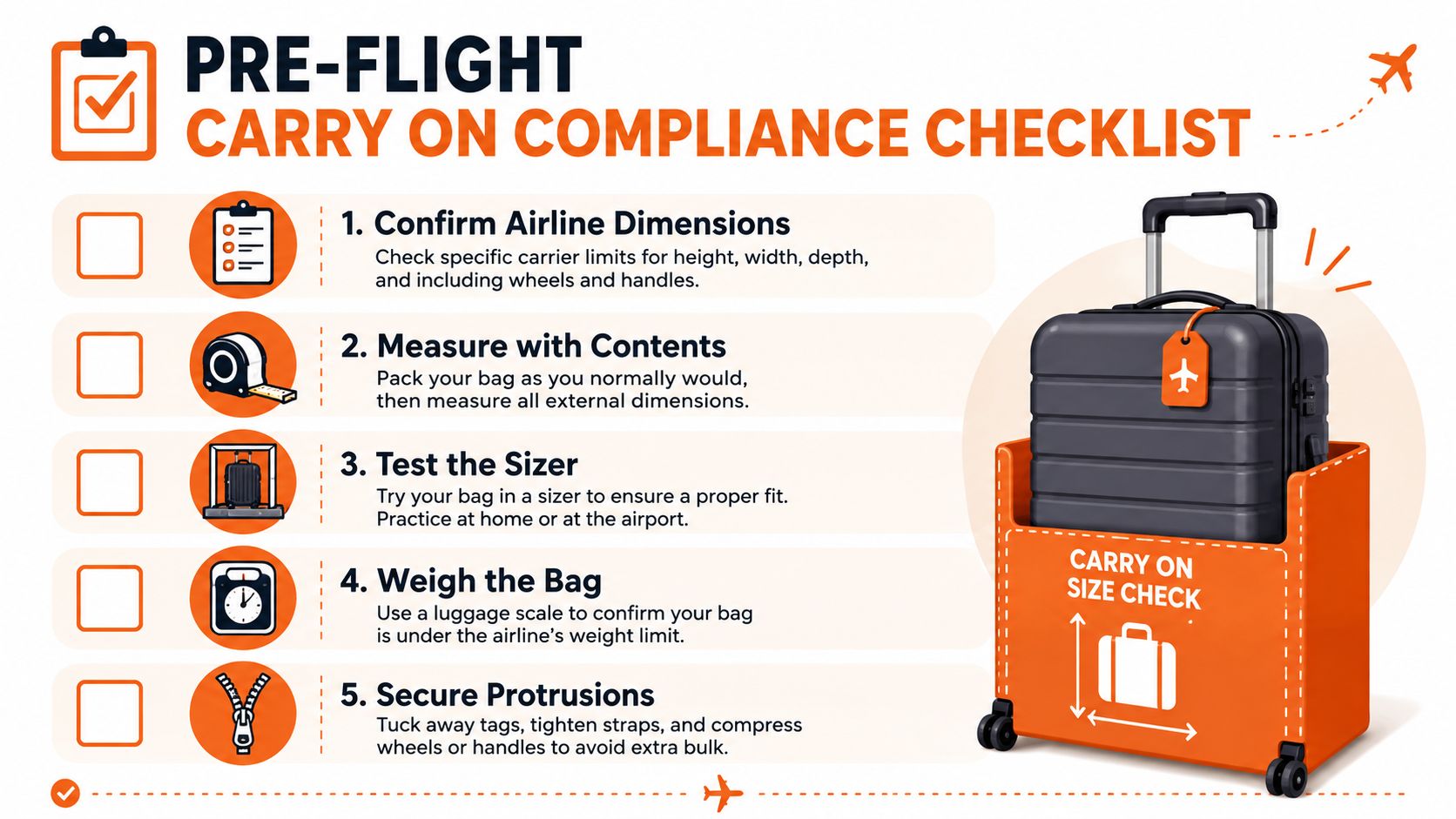
- Confirm the exact airline dimensions. Check the carrier's current baggage page for your fare and operating airline. A saved screenshot or retailer size chart may not reflect the rule applied to your flight.
- Measure the packed bag. Include wheels, handle housings, handles, pockets, straps, latches, and expansion panels. Record height, width, and depth at the outermost points.
- Test a realistic sizer. Recreate the airline's published opening with a box or marked space, then insert the packed case. If it fits only when you press down hard or force the sides inward, it has too little margin for a crowded gate.
- Weigh it when the itinerary requires it. International and budget carriers may check weight as well as dimensions. Remove dense items or redistribute them before leaving home.
- Check the personal item separately. Test your backpack or tote in a seat-sized space and look for bulging panels. Keep passports, medication, chargers, and travel documents accessible without overloading the bag.
Gate conditions can change the practical result. Crowded flights may bring closer inspection, while a smaller regional aircraft can reduce available bin space. A connecting segment operated by a partner may apply a different maximum, even when the booking displays one airline's name.
Soft-sided luggage gives you some flexibility. Compressible clothing can settle inside the bag, but compression cannot shorten wheels, handles, or a rigid frame. A reusable system such as the VacuFly Travel Compression Kit, 15 Vacuum Bags + Cordless Pump can remove air from suitable clothing without requiring a household vacuum or wall outlet. Recheck the packed suitcase afterward. Clothing that looks compact can still push the exterior beyond the sizer.
Save the airline's baggage page, measure the complete packed case, and leave enough room for the closure to work naturally. These habits reduce gate-check surprises more reliably than choosing a suitcase by its advertised body height alone.
For a final check, lift the bag by its normal handle, inspect every protruding part, and confirm that the personal item still closes. A compliant bag needs to fit as packed, not only as manufactured.
Produced via Outrank