


Vacuum Bags for Travel Clothes: The Complete Practical Guide
You're standing on a suitcase that still won't close. The jacket takes up half the compartment, the sweaters have turned the rest into a soft brick, and the airport departure is getting closer. Rolling everything tighter may create a little room, but it won't change the basic problem: bulky fabric contains a lot of air.
Vacuum bags for travel clothes can help by removing that air. They can also create new problems, including wrinkles, slower access, unreliable seals, and awkward security inspections. The practical question isn't whether compression works in theory. It's whether your clothing, itinerary, and carry-on habits make the trade-off worthwhile.
If bulky clothes are the reason your suitcase still will not close, fix that before your trip gets more expensive or stressful. The VacuFly Travel Compression Kit, 15 Vacuum Bags + Cordless Pump helps you compress coats, sweaters, and puffy layers fast, so you can pack more, avoid last-minute baggage problems, and leave with a bag that actually zips.
Table of Contents
- Why Carry-On Compression Matters More Than Ever
- How Vacuum Compression Works for Travel
- Materials, Seals, and Durability That Hold Up on the Road
- Key Features to Evaluate Before You Buy
- Real-World Travel Scenarios and What to Expect
- The Honest Trade-Offs Most Guides Skip
- Should You Use Vacuum Bags for Your Next Trip
Why Carry-On Compression Matters More Than Ever
A tightly packed carry-on forces several decisions at once. You may need a warm layer for the flight, formal clothes for a meeting, spare outfits for weather changes, and enough room to bring home purchases. Shoes, toiletries, and electronics already compete for fixed space, so bulky clothing often becomes the deciding factor.
That pressure has made luggage efficiency a practical concern rather than a packing hobby. Travelers trying to avoid checked baggage want to carry more useful clothing without exceeding the physical limits of a cabin bag. A compression bag addresses volume, not weight. That distinction matters because removing air can make a jacket smaller, but it doesn't make the jacket lighter.
The packing problem compression can solve
Consider two travelers taking the same trip. The first packs mostly thin shirts, underwear, and lightweight trousers. The second needs a winter coat, thick knitwear, and down gear. Both may use the same bag system, but the second traveler has far more compressible volume to recover.
That's why vacuum bags shouldn't be judged by the promise of fitting an entire wardrobe into any suitcase. They're more useful when the suitcase contains soft, bulky items that expand after packing. For thin clothing, packing cubes, folding, or rolling may provide a simpler experience with easier access.
Practical rule: Compression solves a volume problem. It doesn't solve an overweight bag, an oversized suitcase, or poor decisions about what to bring.
The rest of the decision comes down to trade-offs. You'll want to know how the bags work, what construction features matter, how they behave in different travel scenarios, and where independent testing has found weaker results. A system that feels efficient at home may be frustrating if you need one shirt at a security checkpoint or during a short hotel stop.
How Vacuum Compression Works for Travel
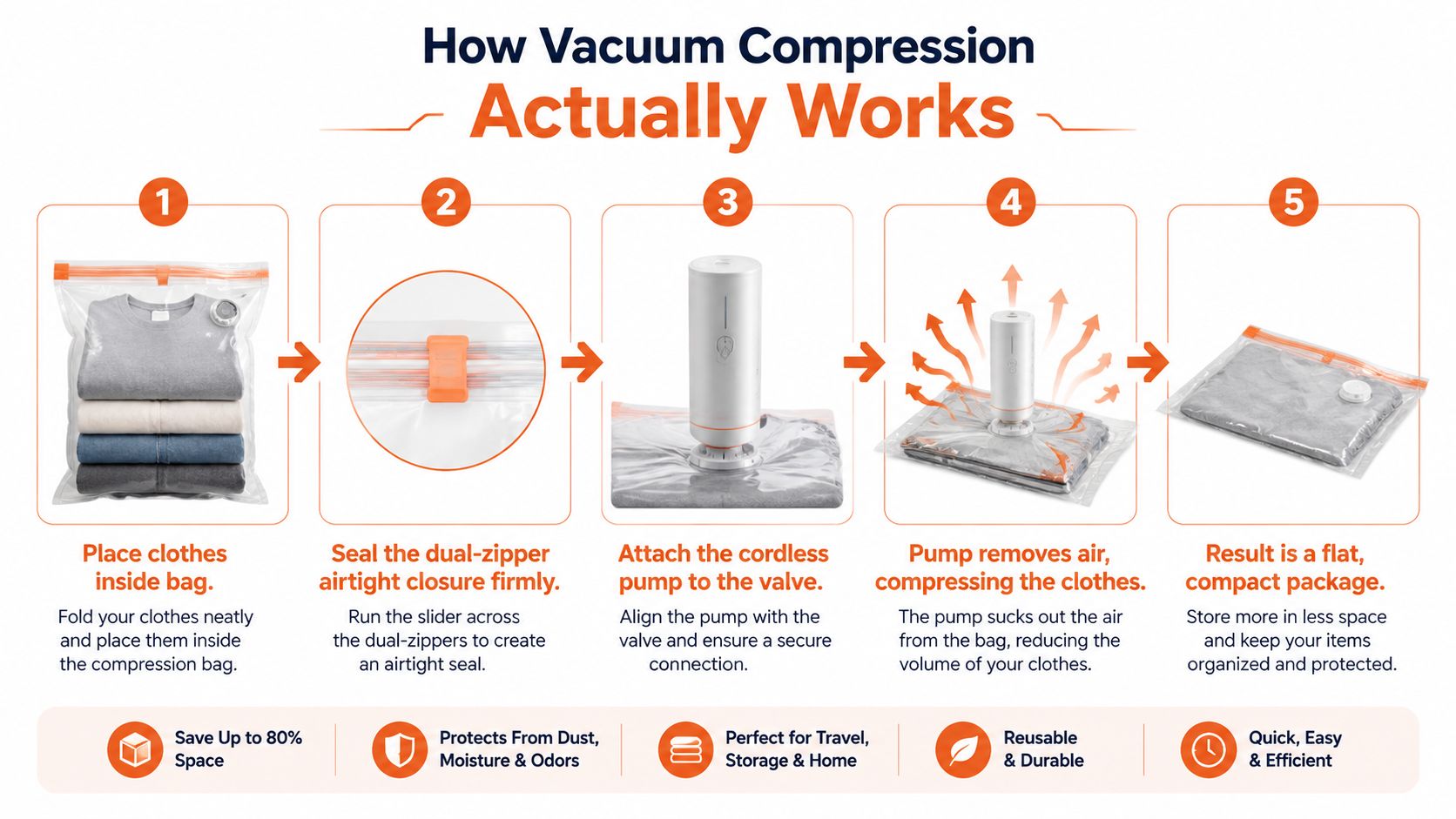
A vacuum travel bag removes air from around folded clothing, then holds the reduced bundle in that shape. The packing sequence is simple:
- Place dry clothes inside, staying below the bag's fill line.
- Close the dual-zipper track firmly.
- Attach the pump to the valve.
- Remove air until the clothing forms a flatter bundle.
- Close or cap the valve, then place the package in the suitcase.
The process resembles squeezing a sponge. The sponge remains present while trapped air leaves, reducing its overall volume. Clothing responds differently, but the same packing principle applies. Compression reshapes clothing and reduces bulk without changing its weight.
Why the closure and valve matter
The pump creates the initial reduction in volume. The zipper and valve keep air from returning. A dual-zipper track provides two lines of contact, while the valve connects to the pump and closes after extraction. A leak in either component lets the bag expand over time.
Cordless pumps make repacking easier away from home. They remove the need for a household vacuum or wall outlet, which helps in a hotel room or during the return journey. The VacuFly Travel Compression Kit, 15 Vacuum Bags + Cordless Pump pairs reusable bags with a cordless pump as one travel-focused setup.
Vacuum bags suit travelers who need to reduce the bulk of larger garments, but the compressed bundle may become dense and harder to access. Opening one bag for a single shirt can also mean repacking the contents later. That trade-off matters more on multi-stop trips than on a direct journey where the bag can remain closed until arrival.
The category extends beyond occasional household storage. Travel and luggage organization represented US$183.20 million in 2025, or 23.4% of global vacuum storage bag revenue, according to MarketIntelo's vacuum storage bag market data. The figures point to a recognizable use case for travelers carrying bulky garments in limited luggage, rather than proving that compression suits every packing style.
Test the seal and valve at home before departure, then check the bag again after repacking.
Materials, Seals, and Durability That Hold Up on the Road
A travel compression bag faces more than the first pump-down. It is folded, pressed against zippers, squeezed in luggage compartments, and opened and resealed during the trip. Film strength and closure quality decide whether it remains useful after repeated handling. A bag that compresses well at home can still become a liability if its seams or valve fail during a multi-stop itinerary.
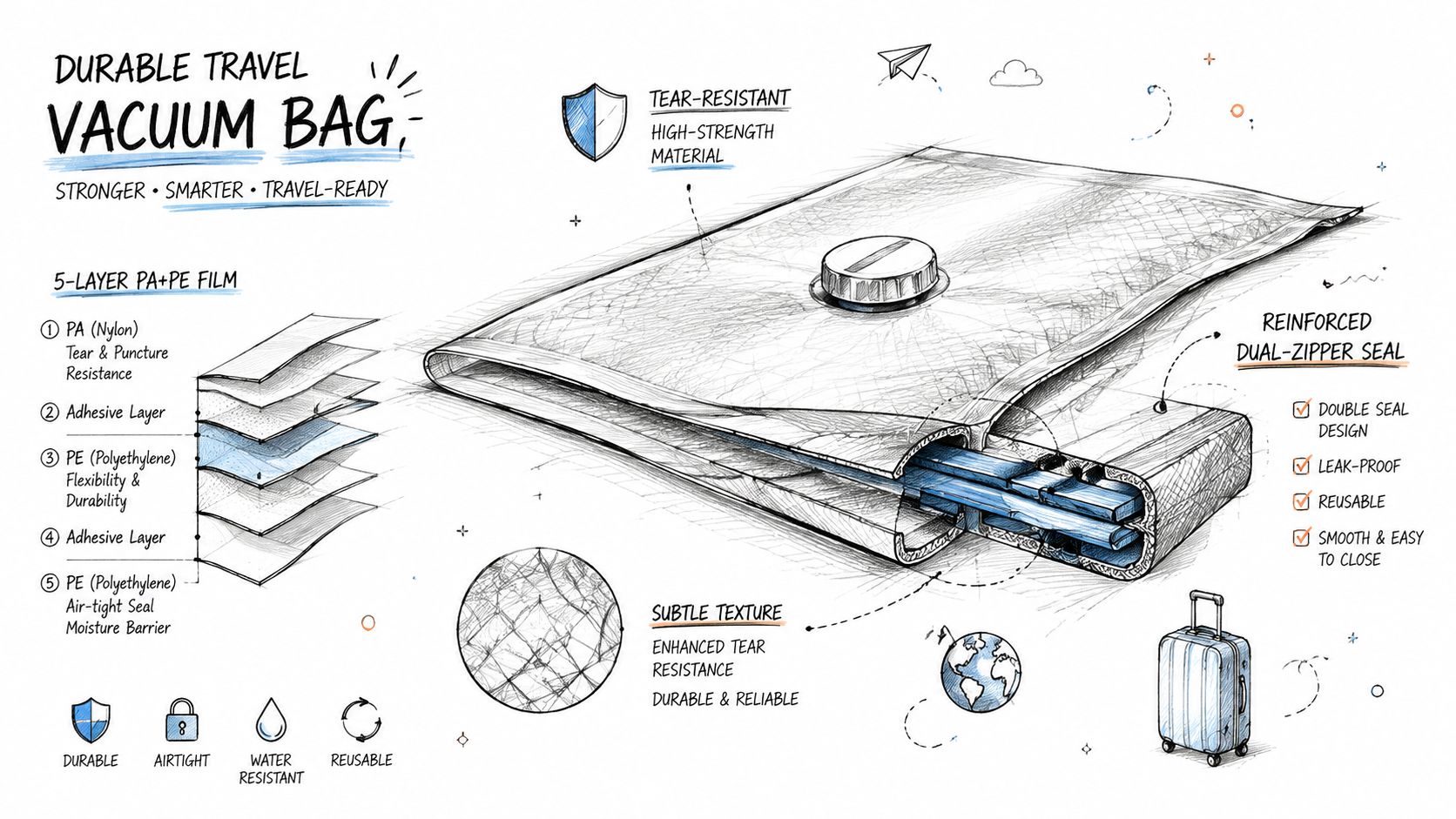
PA+PE film is common in reusable vacuum bags. Its layered construction can balance flexibility with tear resistance, but material thickness still matters. A very thin bag may perform well in a cupboard and fail when a sharp zipper edge, belt buckle, or rough suitcase seam presses against it.
What to inspect before packing
Start with the film. Choose a reusable, tear-resistant material if you expect several trips, rather than a disposable storage sheet. Washable construction helps when the bag carries worn clothing or picks up ordinary travel grime.
Then inspect the zipper track. A reinforced dual-zipper seal should close evenly from end to end. Run the slider across the entire track and check for trapped fabric or lint. A small obstruction can leave a path for air to enter, reducing compression before the bag reaches your destination.
The valve needs the same attention. It should sit firmly on the bag, connect securely to the pump, and close without excessive force. A screw-cap design adds another closure step, so confirm that the cap stays attached and cannot easily disappear in a hotel room.
Reusable versus disposable construction
Disposable bags can suit one storage task, but repeated travel places greater stress on seams and closures. Reusable bags are more practical when you will unpack and repack during a long itinerary. They also let you separate clean clothing from laundry without replacing the whole system.
For more guidance on construction and selection, see this vacuum storage bag buying guide. Any system still needs sensible handling. Keep sharp objects outside the bag, avoid forcing an overfilled zipper, and position the compressed bundle where suitcase hardware will not rub against it repeatedly. Durability improves when the bag is treated as protective packing equipment, not an indestructible container.
Key Features to Evaluate Before You Buy
The pump gets most of the attention, but a travel bag is a system. The valve, zipper, film, bag dimensions, and recharge method all affect how convenient it is after the first packing session.
Start with the valve
A screw-cap valve usually gives you a clear mechanical closure after pumping. It can feel reassuring because you can tighten it by hand, but the cap must remain attached and properly closed. A push-button valve can be faster to operate, though it may be less intuitive if you're unsure whether it has fully locked.
Neither design removes the need to test the seal. Compress one bag at home, leave it undisturbed, and check whether it expands before you rely on the system for a flight.
Compare the closure and pump options
A dual-zipper track generally offers more sealing contact than a single track. That doesn't guarantee perfect retention, but it gives you a stronger design starting point. The zipper should move smoothly and close completely, without clothing caught in the channel.
Pump choice changes the experience even more. A cordless USB-C rechargeable pump works independently of a household vacuum and is easier to use in a hotel. The VacuFly catalog describes its pump as rated for up to 90 compressions per charge, while some household-vacuum-compatible systems require an adapter and access to a full-size vacuum.
| Feature | Screw-Cap Valve | Push-Button Valve | Dual-Zipper Seal | Single-Zipper Seal |
|---|---|---|---|---|
| Main advantage | Hand-tightened closure | Quick operation | More sealing contact | Simpler construction |
| Travel concern | Cap can be misplaced or incompletely tightened | Locking action may be less obvious | Needs careful cleaning and full closure | May offer less redundancy |
| Best fit | Travelers who prefer a visible mechanical cap | Travelers prioritizing speed | Repeated travel and longer storage | Occasional, light-duty use |
Match the bag size to the clothing
Large bags are useful for coats and sweaters, but they can become awkward bricks in a small carry-on. Smaller bags work better for shirts, underwear, or a single outfit grouping. A mixed set gives you more control than filling one oversized bag with unrelated clothing.
Before buying, check whether the kit includes the pump, the cable, compatible valves, and multiple sizes. The VacuFly travel compression kit is described as including 15 bags and a cordless pump, but you should still confirm the current contents and variant before ordering.
Real-World Travel Scenarios and What to Expect
The same compression system behaves differently depending on the trip. A carry-on-only flyer, a winter vacation traveler, and a digital nomad may all value space, but they won't use the bags in the same way.
The carry-on-only traveler
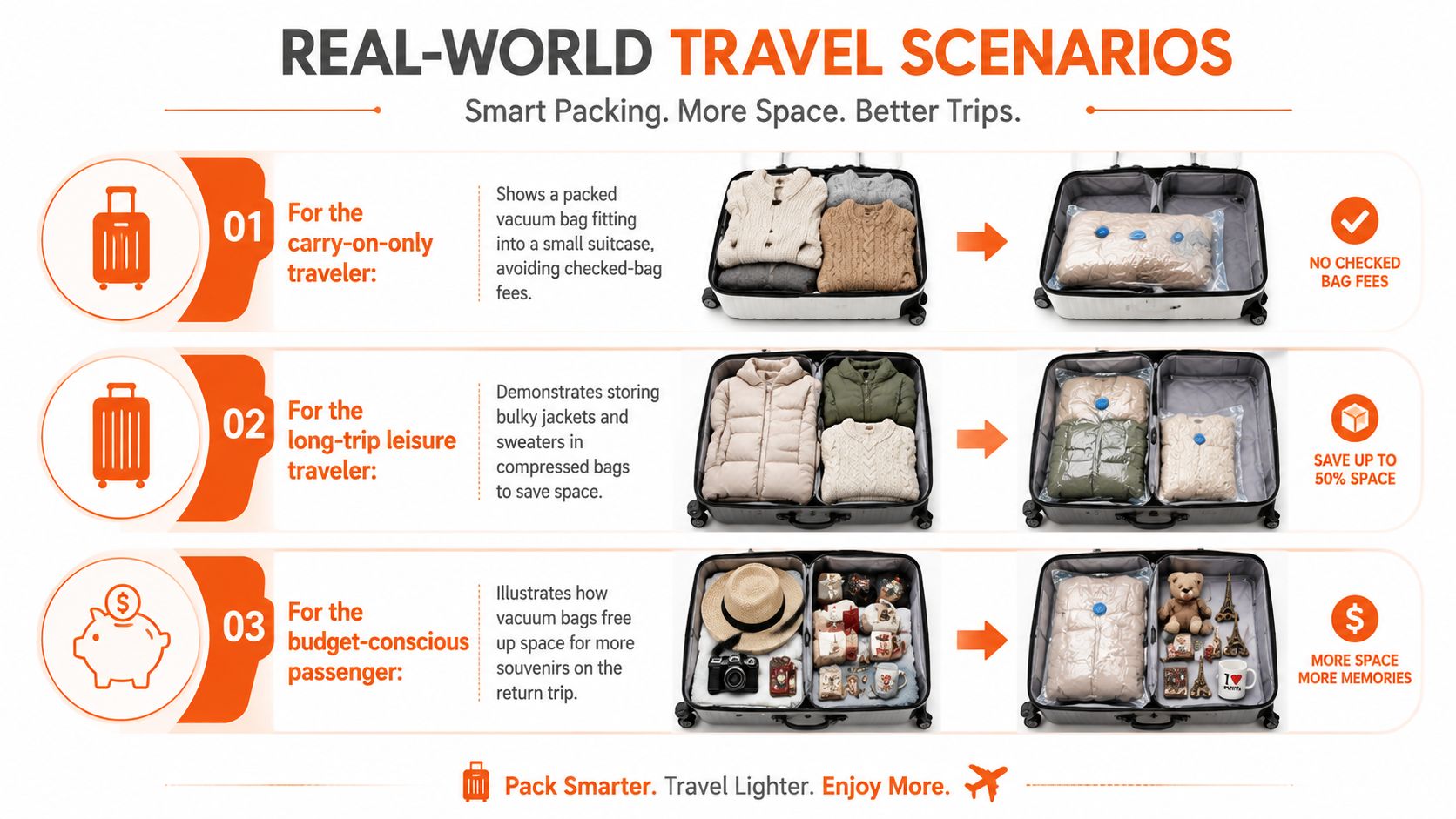
A traveler avoiding checked baggage usually benefits most when the bag contains a jacket, sweater, or other soft item that expands aggressively. Compressing those pieces can free room for toiletries, shoes, or a second layer.
The drawback appears at security. The TSA guidance on vacuum-sealed bags says clothing bags are allowed but not encouraged, and officers may open them if they trigger an alarm during screening. Keep that possibility in mind when deciding whether to seal every garment.
The long-trip leisure traveler
A longer holiday often involves changing weather and more substantial clothing. A winter traveler may use one bag for knitwear and another for outer layers, keeping categories separate and making the return pack less chaotic.
Compression is most valuable here when the clothing is bulky rather than merely numerous. It won't turn a heavy coat into a featherweight item, and it won't create extra room if shoes or rigid packing organizers already fill the case.
The multi-destination traveler
Digital nomads and travelers moving between cities need a system that can be reopened without destroying the whole suitcase. Use separate bags for clothing groups instead of placing the entire wardrobe in one package. That way, you can access workwear, casual clothes, or laundry without unpacking everything.
Repacking also matters. A cordless pump can restore the compressed shape away from home, but you should leave room rather than filling every gap created on the outbound journey. Souvenirs, food, and destination-specific purchases still need somewhere to go.
The best setup doesn't maximize the number of garments. It keeps the items you actually need accessible while reducing the volume of the pieces that would otherwise dominate the bag.
The Honest Trade-Offs Most Guides Skip
Vacuum bags are selective space-saving tools, not universal solutions. Independent coverage found that compression reduced packed volume by about 15% to 30% on average, with the strongest gains in bulky items such as jackets, sweaters, and down gear. Lightweight clothing, including T-shirts, underwear, and thin pants, often gained less than 8%, according to comparative coverage of compression bags, packing cubes, and rolling.
The packing decision follows from that difference. A suitcase filled with thin fabrics may gain little useful room while requiring extra handling. Bulky insulation gives compression a clearer purpose, although it still does not reduce the clothing's weight.
Access is the hidden cost
Packing cubes are easier to open, browse, and close. Vacuum bags require you to break the seal, retrieve an item, and often pump the remaining clothes again. Comparative testing reported that 67% of testers had to re-pump at least one bag during transit, while retrieving one item took an average of 82 seconds with vacuum setups versus 14 seconds with packing cubes. The broader side-by-side comparison of packing cubes, rolling, and vacuum compression puts that time cost in context.
That friction matters on trips where you repeatedly need a charger, shirt, or base layer. Keep frequently used items in quick-opening organizers, and reserve sealed bags for clothing that can remain undisturbed.
Wrinkles and seal retention
Tight compression can crease garments, particularly when clothes are folded unevenly or the bag is overfilled. It can flatten a bundle without leaving every garment ready to wear. Business attire and delicate fabrics require more care than casual knitwear, so they may belong in a cube or garment sleeve instead.
Seals can loosen after about a week under normal travel conditions because of handling, temperature, and pressure changes, according to TSA guidance on vacuum-sealed bags. Test the system before departure, avoid depending on maximum compression throughout the itinerary, and keep another packing option available for clothing you cannot afford to lose access to. For product-specific use and care questions, consult the VacuFly FAQ for travel vacuum bags before leaving.
Should You Use Vacuum Bags for Your Next Trip
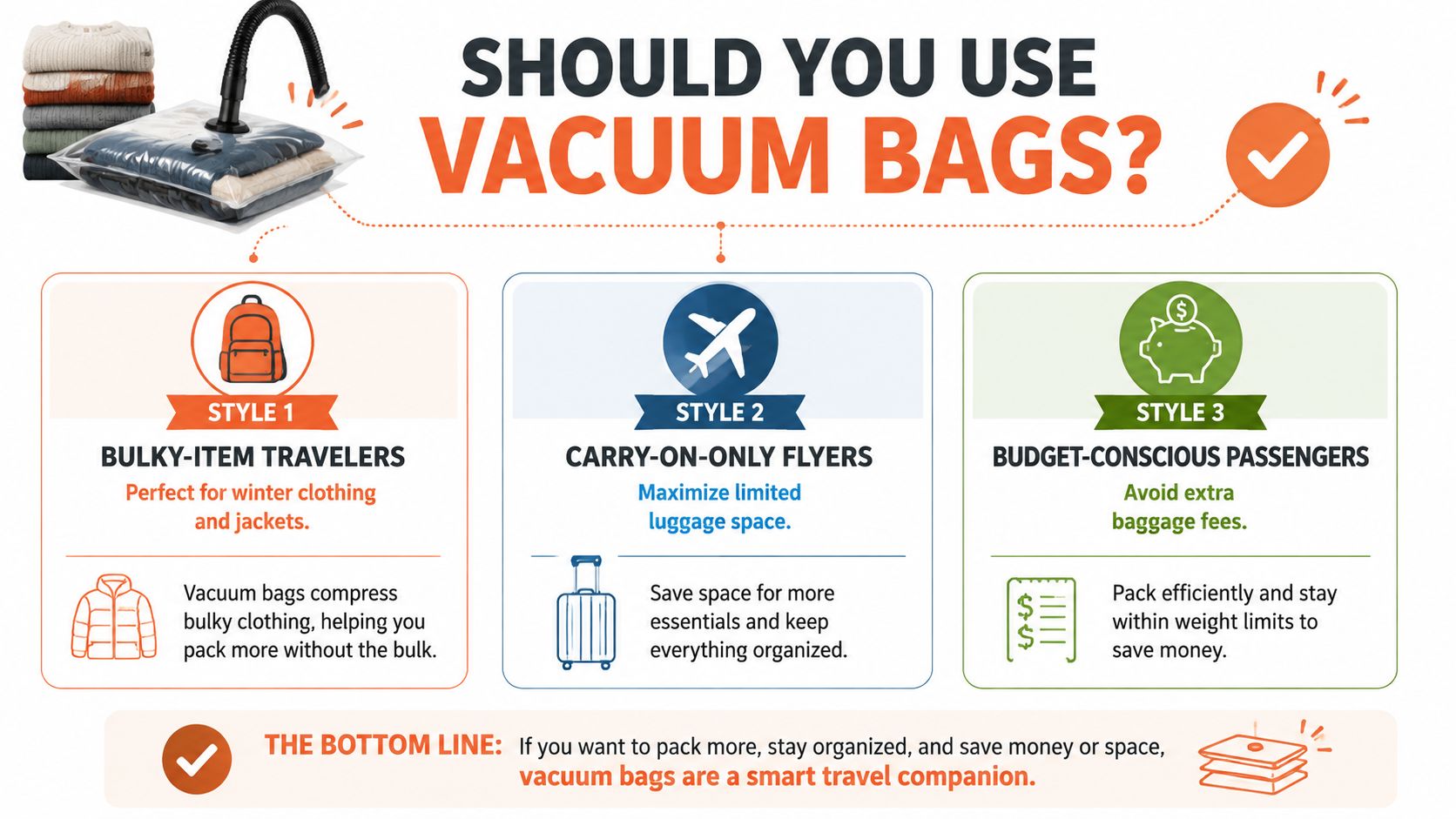
Start with the clothing, not the bag. Vacuum bags make the most sense when bulky layers are limiting your carry-on: jackets, sweaters, down gear, and thick winter clothing can justify the extra pumping and handling. Travelers avoiding checked luggage may also benefit when every compartment matters.
A different setup works better for light wardrobes or trips that require frequent access. Opening a compressed bag repeatedly slows packing and can leave clothes more wrinkled. Frequent hotel changes, security-sensitive itineraries, and delicate garments also reduce the practical benefit. If you do want a travel-specific setup, the VacuFly Travel Compression Kit combines reusable bags with a cordless pump, which makes it easier to repack on the return trip or between hotel stops.
Use this decision test
- Bulky-item traveler: Compress one or two bags of winter layers, while keeping everyday clothing accessible.
- Carry-on flyer: Test the filled bags in your actual case and leave room for inspection or repacking.
- Frequent-access packer: Store daily essentials in packing cubes and seal backup or destination-specific clothing.
- Long-trip traveler: Choose reusable bags and a portable pump so you can reorganize after laundry and before the return flight.
- Light packer: Skip the equipment if your clothing already fits comfortably without compression.
A useful trial costs little: lay out the clothes you normally pack, separate thick layers from thin basics, and compress only the first group. Retrieve an item after packing, then judge whether the space saved compensates for the added steps. Clothing that stays sealed for most of the journey is a better candidate than garments needed every day.
The final choice depends on your wardrobe, itinerary, and tolerance for repacking. What matters most is how your clothing is organized and how often you need to access it during travel.
VacuFly offers reusable travel compression bags in three sizes paired with a cordless pump, so you can reduce bulky clothing without needing a household vacuum or wall outlet. If that setup matches your carry-on strategy, visit VacuFly to review the travel kit and choose a packing approach based on your actual wardrobe.
Powered by the Outrank app