


Carry on Bag vs Personal Item: The Complete 2026 Guide
You're at the gate with a compact roller that fit perfectly on your last flight. This time, the agent points to the sizer, the bag's wheels and handles push it beyond the limit, and the overhead-bin space is already disappearing. The difference between a carry-on bag and a personal item suddenly becomes a fee, a gate check, or a stressful repack.
Airlines don't apply one universal cabin-baggage rule. Published allowances vary by airline, fare, route, and aircraft, while under-seat space can be tighter than a generic chart suggests. The safest approach is to treat dimensions as a starting point, then verify the exact flight you've booked.
Table of Contents
- Why the Carry On Bag vs Personal Item Distinction Matters
- Carry On Bag and Personal Item Dimensions Explained
- How Airlines Enforce Carry On and Personal Item Rules
- The Hidden Variable of Aircraft Type and Fare Class
- Carry On Bag vs Personal Item Fee Structures
- Packing Strategies to Maximize Both Bag Allowances
- How to Choose the Right Bag Strategy for Your Trip
Why the Carry On Bag vs Personal Item Distinction Matters
A carry-on bag and a personal item both travel in the cabin, but they serve different storage spaces. The carry-on goes in the overhead bin. The personal item must fit beneath the seat in front of you, leaving the overhead compartment available for larger cabin luggage.
That distinction became more important as airlines standardized cabin-baggage enforcement and separated the smaller under-seat allowance from overhead-bin luggage. The personal item became the basic free option on many fares, while the carry-on became the larger capacity choice. A traveler who assumes a backpack counts as a personal item can discover the problem only when the backpack won't slide under the seat.
Gate conditions make the difference more noticeable. On a full flight, agents may check bags against a sizer before boarding, and an item that was accepted casually on a quiet flight may receive closer attention when overhead space is limited. Regional aircraft can create another problem because their bins and under-seat areas may offer less usable space than a standard single-aisle aircraft.
Practical rule: A bag's category depends on the allowance attached to your ticket and where it must be stored, not on what the bag looked like in an online product photo.
The financial consequences can be immediate. Some ultra-low-cost carriers charge separately for overhead carry-ons, with listed fees ranging from about $10 to $75, depending on the airline and timing, while the personal item is generally free. Skyscanner's 2026 airline baggage comparison documents that pricing split and explains why travelers increasingly compress clothing to stay within a smaller allowance.
The rest of the decision is practical. You need to know the dimensions, understand how agents measure bags, check the aircraft and fare restrictions, and pack soft goods so they use available volume without creating an oversized or overweight bag.
Carry On Bag and Personal Item Dimensions Explained
The most widely used global reference for cabin luggage is the International Air Transport Association's baggage guidance, which gives a carry-on guideline of 56 × 45 × 25 cm, or 22 × 18 × 10 inches, including wheels and handles. IATA also notes that many airlines apply weight limits that commonly start at 5 kg, or 11 lb. The operating airline still sets the final allowance, so that guideline isn't a guaranteed entitlement on every ticket.
In the U.S. market, a 2026 comparison found that the common overhead-bin ceiling across major carriers clusters around 22 × 14 × 9 inches. Personal-item limits are smaller and vary more sharply, commonly appearing around 18 × 14 × 8 inches or 17 × 10 × 9 inches, depending on the airline. SmarterTravel's personal-item comparison describes the dimensional gap as roughly 20–35% larger by linear volume proxy for the carry-on envelope.
The table shows why geometry matters. A hard-sided case with a rigid frame may technically match a listed width but fail because its wheels, corner guards, or expanded exterior pockets add depth. A soft backpack can be easier to compress, but overfilling it may make the bag too thick to slide beneath the seat.
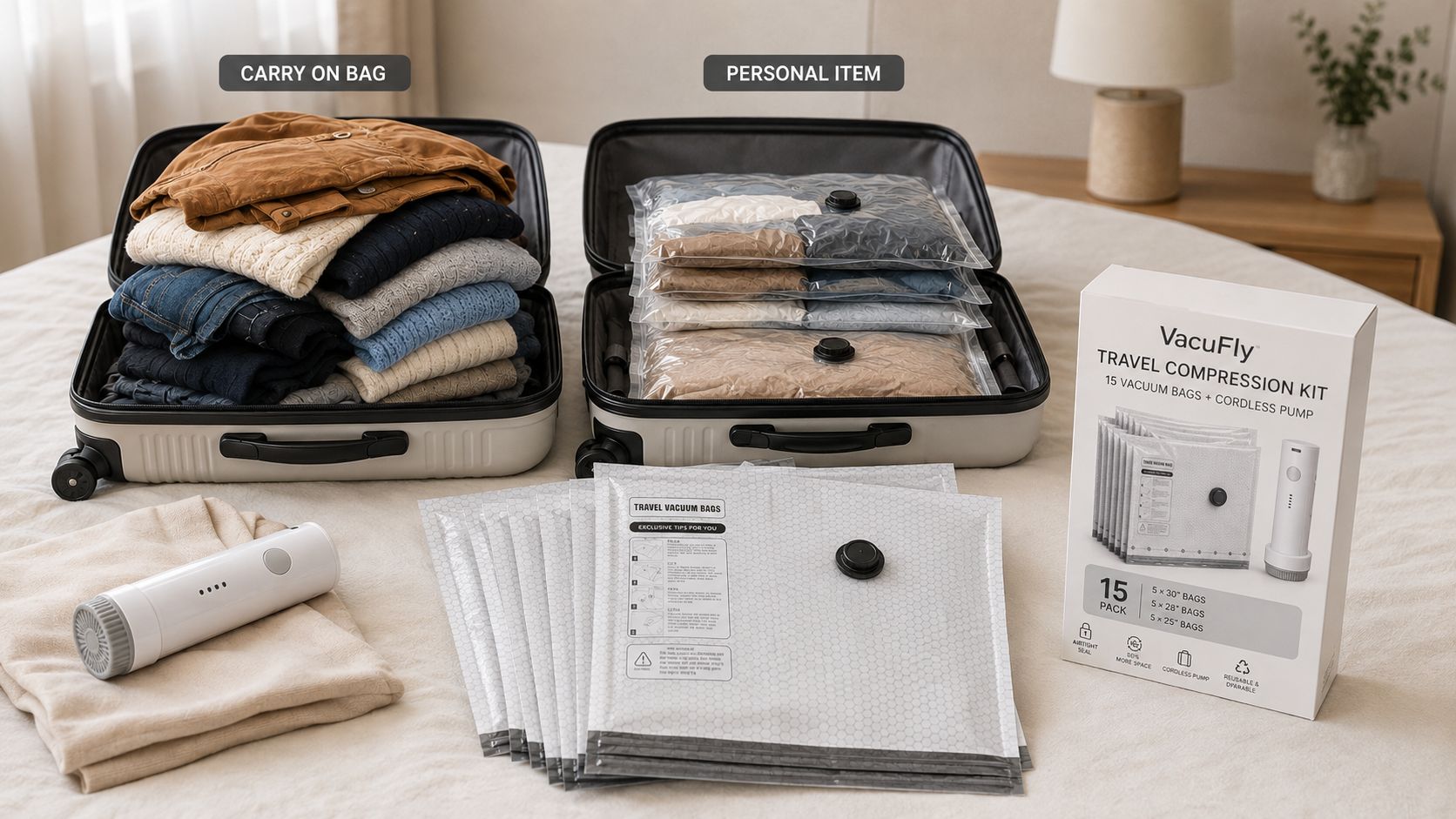
For a practical explanation of measuring luggage accurately, including exterior components, use this carry-on bag measurement guide. If soft clothing is consuming the available volume, the VacuFly Travel Compression Kit, 15 Vacuum Bags + Cordless Pump is one example of a reusable compression system designed to remove air from clothing, with the catalog snapshot stating up to 80% packing-space savings for compressible items.
The key point is simple: measure the packed bag, not the empty shell. A carry-on can exceed its allowance through bulging fabric, while a personal item can lose its under-seat fit when a laptop sleeve, water bottle, or jacket fills the exterior pockets.
How Airlines Enforce Carry On and Personal Item Rules
Published dimensions matter, but airport enforcement turns those dimensions into a physical test. Agents may ask you to place a carry-on in a sizing frame, and they can assess whether the bag fits without forcing it. Wheels, handles, and external pockets count because the airline is measuring the object that enters the cabin, not the fabric panel that forms its main compartment.
Some carriers use a 45-linear-inch total for carry-on measurements, meaning the relevant dimensions are added together rather than judged only by one side. American Airlines' carry-on policy also emphasizes that wheels and handles are included in the measurement. A bag that looks compact from the front can still fail when its depth is excessive.
Five airport tests that matter
- Overhead fit: The carry-on must enter the sizer or overhead bin without being forced.
- Under-seat fit: The personal item needs to fit fully beneath the seat, not merely occupy the space in front of your legs.
- Packed shape: Soft bags can help when lightly compressible, but bulging panels and overfilled pockets work against you.
- Weight: IATA notes that airline weight limits commonly start at 5 kg, or 11 lb, on many carriers. The limit is carrier-specific, so check the ticket rules.
- Boarding pressure: Full flights and limited bin space can lead agents to enforce the written allowance more closely.
Carrier variance is substantial. Industry comparison data identifies Southwest with a 24 × 16 × 10-inch carry-on allowance, while some airlines set personal-item ceilings near 16 × 12 × 6 inches. Those are very different packing environments, even when both tickets describe the luggage as cabin baggage.
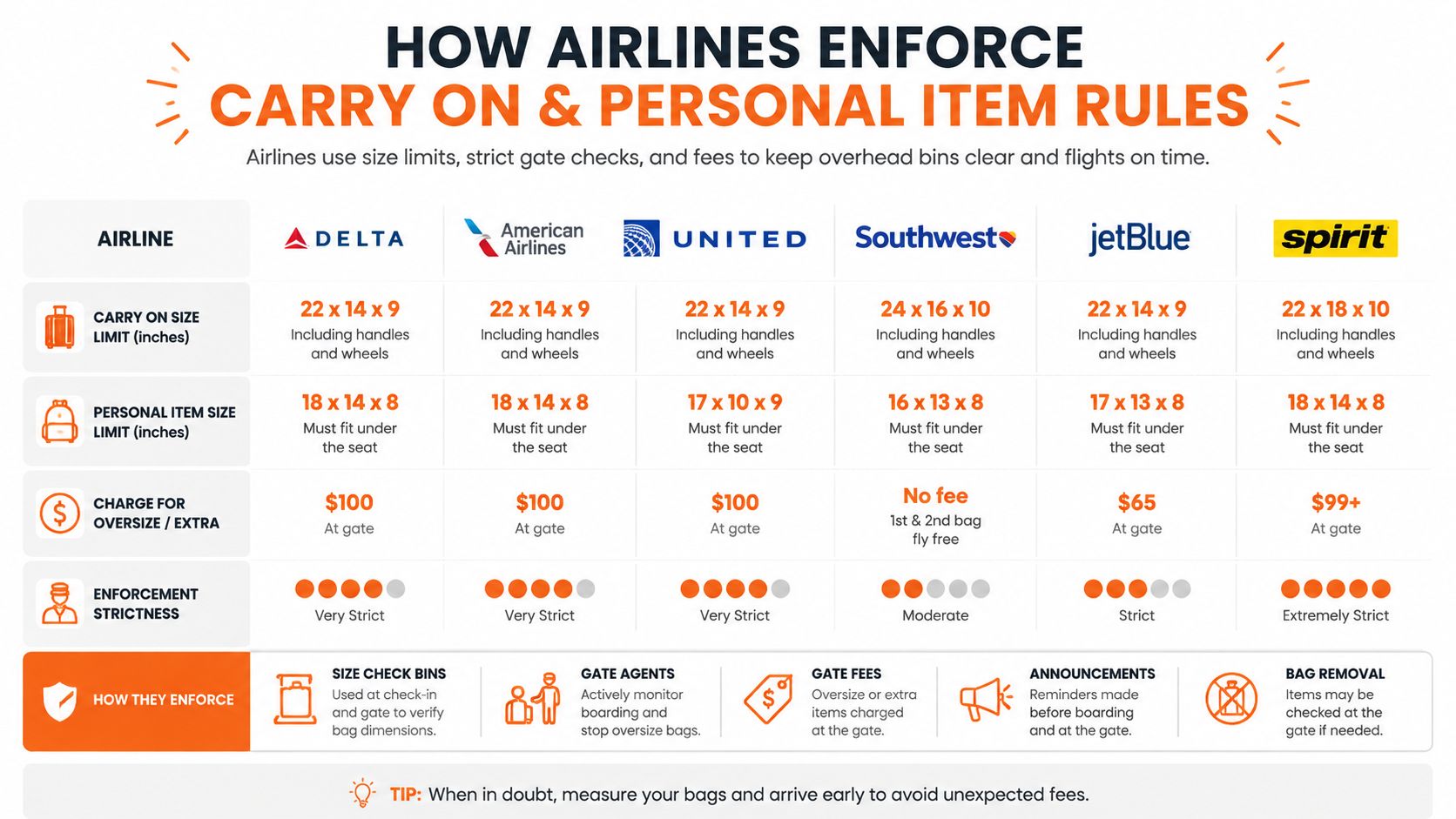
The most reliable bag has a little flexibility around the edges. A soft-sided personal item can adapt to the seat structure better than a rigid box, but flexibility isn't permission to exceed the stated dimensions. If the bag must be pushed, twisted, or emptied at the gate, it wasn't packed for that airline's enforcement pattern.
The Hidden Variable of Aircraft Type and Fare Class
The assumption that an airline has one permanent baggage rule causes many avoidable surprises. Airline policy pages may publish a general allowance, but the applicable restriction can change with the aircraft, route, fare, or operating carrier. Air Canada's carry-on guidance reflects this broader issue, with allowances and restrictions that can vary by itinerary and aircraft.
The same backpack may fit comfortably beneath a seat on one aircraft and meet resistance on another. Regional jets often have smaller overhead compartments and tighter under-seat clearances. A roller accepted on a larger aircraft might need to be gate-checked on a smaller one, even when the booking uses the same airline brand.
Fare rules can change the bag you're allowed to bring
A basic fare may include only a personal item, while another fare on the same route includes an overhead carry-on. Some routes also attach different baggage conditions to specific fare families. That means the question isn't whether your bag matches a generic airline dimension. It's whether your ticket grants access to the storage location you're planning to use.
Check these details before packing:
- Operating carrier: The airline selling the ticket may not be the airline operating the flight.
- Aircraft type: Look for the aircraft listed in the booking details, while recognizing that airlines can change equipment.
- Fare family: Confirm whether the ticket includes an overhead bag or only an under-seat item.
- Route restrictions: Read the baggage terms attached to the specific itinerary, not just the airline's general landing page.
- Connection rules: A bag accepted on the long-haul segment may face different conditions on a regional connection.
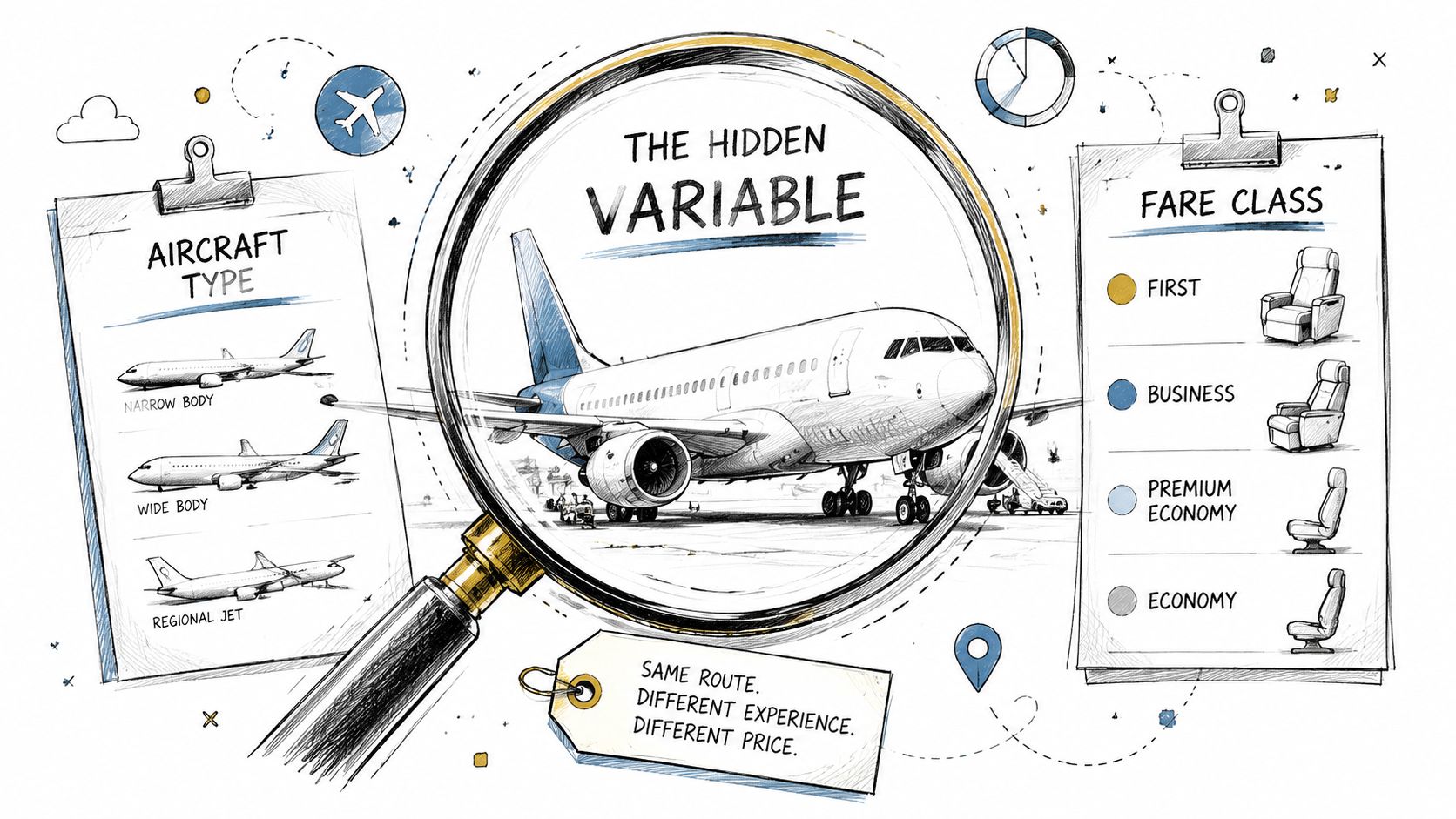
Static charts become outdated quickly because airlines continue to update fare and aircraft-specific policies. Use them to understand the categories, then open the baggage rules shown in your reservation and check again shortly before departure.
Carry On Bag vs Personal Item Fee Structures
The personal item has become the baseline free allowance on many tickets because it uses space beneath the seat rather than competing directly for overhead-bin capacity. The carry-on functions as a capacity upgrade, especially on fares that restrict passengers to one under-seat bag.
That pricing structure changes the packing decision. Paying for a carry-on may make sense when you need volume, but it doesn't automatically make sense to bring one. Compare the cost of the overhead allowance with the cost and inconvenience of checking a bag, then consider whether soft clothing can be reduced enough to fit the free personal item.
A practical packing sequence
- Remove unnecessary bulk: Choose a small, coordinated wardrobe instead of packing separate outfits for every day.
- Use the personal item for high-value access: Keep documents, electronics, medication, and valuables beneath the seat.
- Reserve the carry-on for volume: Put clothing and other bulky, nonessential items in the overhead bag.
- Compress soft goods carefully: Vacuum compression can reduce the volume of compressible items, but it doesn't remove their weight.
- Leave expansion space: A bag that closes at home may swell after you add souvenirs, a jacket, or airport purchases.
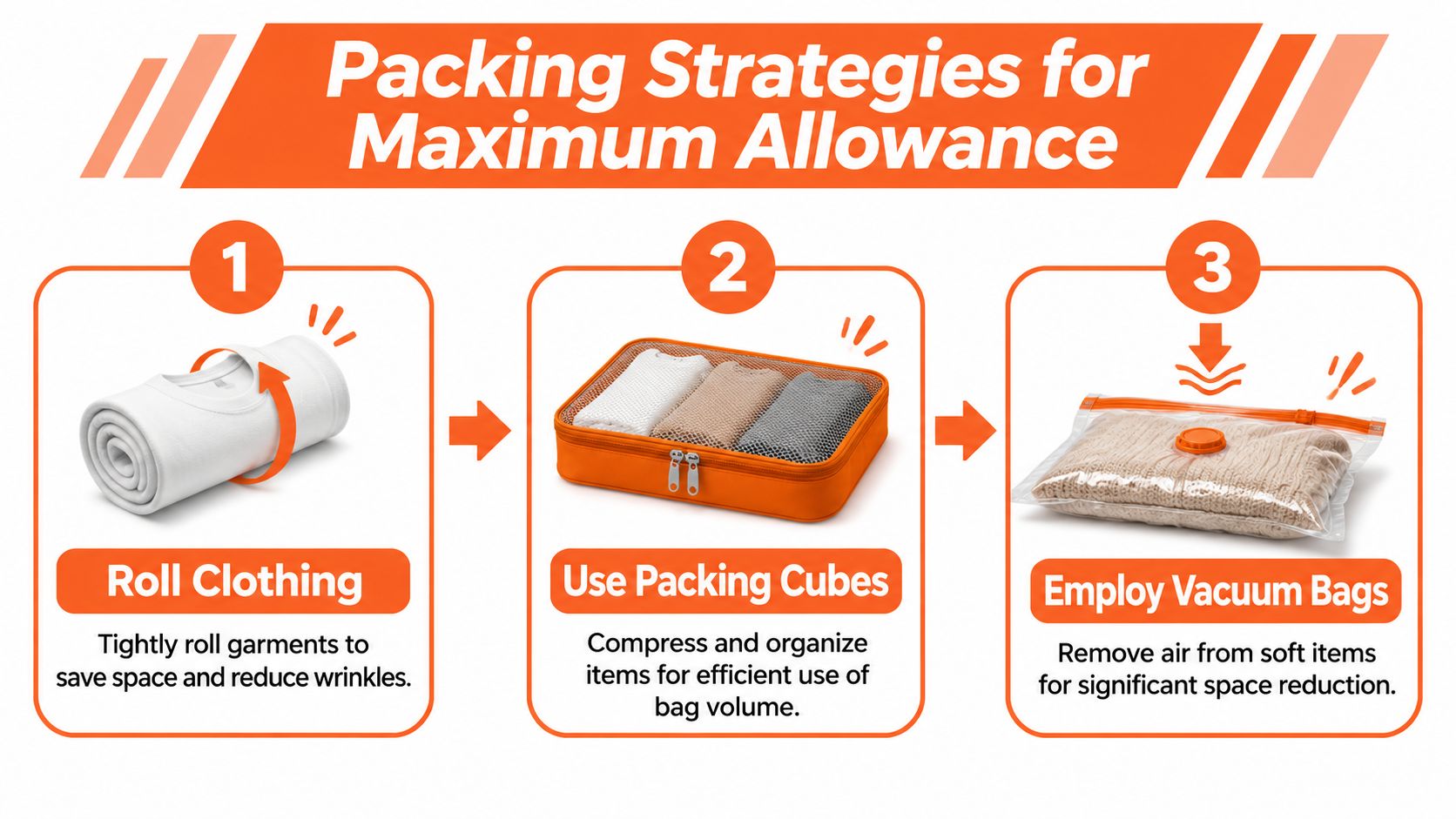
Compression works best when the alternative is paying for unused volume. It won't solve a weight restriction, and it won't make a rigid bag physically smaller if the case itself is already at the limit. It can, however, help soft clothing occupy less of the internal space so you can choose a smaller bag or avoid adding a second piece.
The right calculation is personal. If the fare allows only a personal item, test that bag fully packed before leaving home. If an overhead carry-on costs extra, decide whether the added capacity justifies the fee or whether a more disciplined wardrobe and compression system can keep the trip within the free allowance.
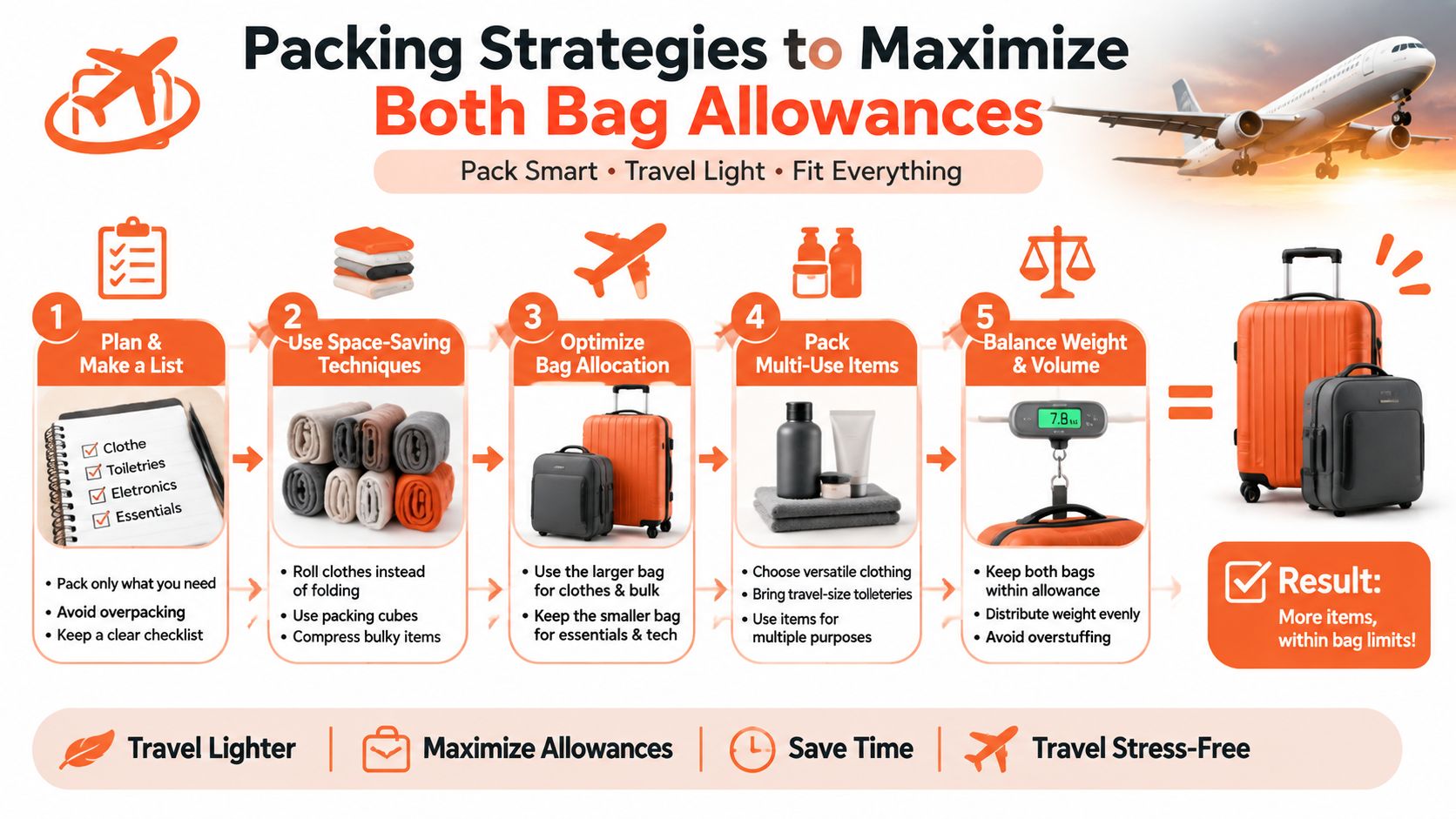
Packing Strategies to Maximize Both Bag Allowances
Start with the storage plan, not the suitcase. The personal item should contain everything you may need during the flight or everything you can't risk losing, while the carry-on should handle clothing and other items that can remain in the overhead bin.
Vacuum compression achieves up to 80% volume reduction on compressible items, and typical users fit about 3× more in the same carry-on. Those figures apply to compressible goods, not shoes, toiletries, electronics, or the bag itself, so the technique improves volume efficiency rather than changing the airline's weight limit.
Use a fill, seal, and pump workflow
Fill each bag without forcing the zipper. Seal it completely, attach the pump to the valve, and remove air until the clothing forms a compact layer. This approach is more consistent than sitting on an overstuffed suitcase and hoping the zipper survives.
A cordless pump is useful during the return journey because hotel rooms and airport lounges may not offer a household vacuum or a convenient wall outlet. Reusable bags with airtight valves and reinforced closures are designed for repeated packing, but you should still inspect the seal before placing compressed items into your luggage.
For a detailed explanation of using vacuum bags with travel clothing, see this vacuum-bag packing guide. Compression is particularly useful for sweaters, jackets, trousers, dresses, towels, and other soft items that trap substantial air. It's less useful for structured garments, hard objects, or anything that needs to remain wrinkle-free.
Assign each bag a job
- Personal item: Place your passport, documents, medication, laptop, chargers, valuables, and in-flight essentials here.
- Carry-on: Use the overhead bag for compressed clothing, shoes, and less urgent items.
- Outer pockets: Keep them slim. A full bottle or thick accessory can make the bag fail an under-seat test.
- Top layer: Put one emergency outfit or essential layer where you can reach it without unpacking everything.
Don't confuse smaller volume with lighter luggage. A compressed bag can make it easy to pack more clothing, but the total mass remains. Weigh the final bag if your airline lists a limit, and avoid filling every newly available gap because it exists.
How to Choose the Right Bag Strategy for Your Trip
Choose the allowance before choosing the bag. A short warm-weather trip may fit in a personal item if the fare permits only that piece, while bulky cold-weather clothing can make an overhead carry-on more practical. Work travel also changes the equation because a laptop, documents, and chargers need protected, immediate access.
Your airline and aircraft come first. Review the reservation for the operating carrier, aircraft type, fare family, and baggage allowance. Then measure the packed bags, including wheels, handles, exterior pockets, and any compression-induced bulges.
Run this pre-flight check
- Confirm the exact allowance: Check the baggage terms attached to your fare, not a generic search result.
- Verify the aircraft: Pay special attention to regional aircraft and connections.
- Measure both bags packed: Test the personal item under a representative seat-like space if possible.
- Check weight: IATA notes that many airline limits commonly start at 5 kg, or 11 lb, but your carrier sets the actual rule.
- Review liquids: Many countries still enforce a 100 ml container limit inside a 1 liter transparent resealable bag for cabin liquids, as summarized in IATA's passenger baggage guidance. This source has already been used earlier, so treat that earlier citation as the reference for the rule.
- Plan the gate: Keep documents and valuables accessible, and don't rely on last-minute reshuffling.
A personal item is the simplest choice when the fare is restrictive and your wardrobe is compact. A personal item plus carry-on gives you better separation between essentials and clothing, but it exposes you to overhead-bin limits and possible fees. Compression is useful when soft clothing is the obstacle, especially if you want to avoid checking a bag, but it won't override a fare restriction or a weight limit.
The VacuFly Travel Compression Kit combines reusable compression bags with a cordless pump, giving carry-on travelers a way to reduce clothing volume at home or while traveling. Use it as part of a measured packing plan, then verify the exact flight rules before you leave.
If bulky clothing is forcing you into a larger bag or an avoidable luggage fee, visit VacuFly to review its reusable compression bags and cordless pump system. Pack your essentials in the personal item, compress suitable clothing separately, and confirm your airline's exact fare and aircraft rules before heading to the airport.
Authored using Outrank